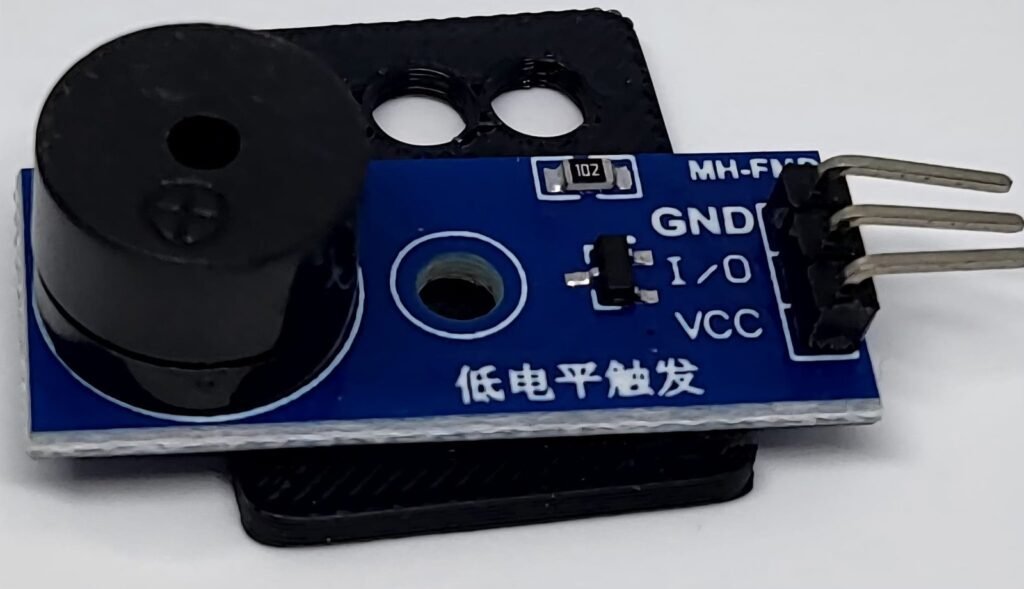
Project 1.10: "Alarm System"
🚀 Project 1.10 – Alarm System
🎯 What You’ll Learn
- ✅ Goal 1: Create simple audible alarms.
- ✅ Goal 2: Combine LED + buzzer for visual and audible alerts.
- ✅ Goal 3: Add activation/deactivation logic and timed alarms.
- ✅ Goal 4: Program different alarm patterns.
Key Ideas
- Digital output: Control LED and buzzer.
- Digital input: Button to activate/deactivate.
- Logic: If/else for alarm states.
- Loops + delays: Control alarm timing.
🧱 Blocks Glossary (used in this project)
pinX = machine.Pin(X, machine.Pin.OUT)→ LED or buzzer output.pinX = machine.Pin(X, machine.Pin.IN)→ Button input.pinX.value(1)→ Turn ON LED/buzzer.pinX.value(0)→ Turn OFF LED/buzzer.midi = music.MIDI(X)→ Buzzer setup.midi.pitch_time(freq, ms)→ Play tone.while True:→ Infinite loop.time.sleep()→ Delay.
🧰 What You Need
| Part | How many? | Pin connection |
|---|---|---|
| D1 R32 | 1 | USB cable |
| LED | 1 | Pin 5 |
| Buzzer | 1 | Pin 26 |
| Button | 1 | Pin 2 |
✅ Before You Start
- USB cable connected
- LED, buzzer, and button wired correctly
- Test print shows:
print("Ready!") # Confirm serial is working
🎮 Microprojects (5 Mini Missions)
🎮 Microproject 1.10.1 – Simple audible alarm
Blocks used: Digital output, External actuator (music), Delay
Block sequence:
- Setup buzzer
- Play tone repeatedly
MicroPython Code:
import machine, time, music                   # Import modules
midi = music.MIDI(26)                         # Buzzer on pin 26
while True:                                   # Infinite loop
    midi.pitch_time(440, 500)                 # Play tone 440 Hz for 500 ms
    print("Alarm tone 440 Hz")                # Serial log
    time.sleep(0.5)                           # Delay
Reflection: Buzzer plays alarm tone.
Challenge: Try different frequencies.
🎮 Microproject 1.10.2 – Visual and audible alarm
Blocks used: Digital output, External actuator, Delay
Block sequence:
- Setup LED + buzzer
- Turn ON together
MicroPython Code:
import machine, time, music                   # Import modules
pin5 = machine.Pin(5, machine.Pin.OUT)        # LED on pin 5
midi = music.MIDI(26)                         # Buzzer on pin 26
while True:                                   # Infinite loop
    pin5.value(1)                             # LED ON
    midi.pitch_time(440, 500)                 # Play tone
    print("LED ON + Alarm tone")              # Serial log
    pin5.value(0)                             # LED OFF
    print("LED OFF")                          # Serial log
    time.sleep(0.5)                           # Delay
Reflection: LED and buzzer work together.
Challenge: Try blinking LED faster than buzzer.
🎮 Microproject 1.10.3 – Activation/deactivation
Blocks used: Digital input, Digital output, Logic
Block sequence:
- Setup button
- If pressed → alarm ON
- Else → alarm OFF
MicroPython Code:
import machine, time, music                   # Import modules
pin2 = machine.Pin(2, machine.Pin.IN)         # Button input
pin5 = machine.Pin(5, machine.Pin.OUT)        # LED output
midi = music.MIDI(26)                         # Buzzer output
while True:                                   # Infinite loop
    if pin2.value() == 1:                     # If button pressed
        pin5.value(1)                         # LED ON
        midi.pitch_time(440, 500)             # Play tone
        print("Alarm activated")              # Serial log
    else:                                     # If button not pressed
        pin5.value(0)                         # LED OFF
        print("Alarm deactivated")            # Serial log
    time.sleep(0.2)                           # Delay
Reflection: Button controls alarm ON/OFF.
Challenge: Add second button for reset.
🎮 Microproject 1.10.4 – Limited alarm time
Blocks used: Digital input, Digital output, Delay
Block sequence:
- Setup button
- Alarm runs for 5s
- Then stops
MicroPython Code:
import machine, time, music                   # Import modules
pin2 = machine.Pin(2, machine.Pin.IN)         # Button input
pin5 = machine.Pin(5, machine.Pin.OUT)        # LED output
midi = music.MIDI(26)                         # Buzzer output
while True:                                   # Infinite loop
    if pin2.value() == 1:                     # If button pressed
        print("Alarm running for 5s")         # Serial log
        for i in range(0, 5, 1):              # Loop 5 times
            pin5.value(1)                     # LED ON
            midi.pitch_time(440, 500)         # Play tone
            time.sleep(1)                     # Delay 1s
        pin5.value(0)                         # LED OFF
        print("Alarm stopped")                # Serial log
Reflection: Alarm runs for limited time.
Challenge: Try 10s duration.
🎮 Microproject 1.10.5 – Different alarm patterns
Blocks used: Digital output, External actuator, Loop
Block sequence:
- Setup LED + buzzer
- Alternate fast/slow patterns
MicroPython Code:
import machine, time, music                   # Import modules
pin5 = machine.Pin(5, machine.Pin.OUT)        # LED output
midi = music.MIDI(26)                         # Buzzer output
while True:                                   # Infinite loop
    # Fast pattern
    for i in range(0, 3, 1):                  # Repeat 3 times
        pin5.value(1)                         # LED ON
        midi.pitch_time(880, 200)             # High tone
        print("Fast alarm")                   # Serial log
        pin5.value(0)                         # LED OFF
        time.sleep(0.2)                       # Delay
    # Slow pattern
    for i in range(0, 2, 1):                  # Repeat 2 times
        pin5.value(1)                         # LED ON
        midi.pitch_time(440, 800)             # Low tone
        print("Slow alarm")                   # Serial log
        pin5.value(0)                         # LED OFF
        time.sleep(0.8)                       # Delay
Reflection: Alarm alternates between fast and slow.
Challenge: Add a third pattern.
✨ Main Project – Alarm System
🔧 Blocks Steps (with glossary)
- Digital input: Button control.
- Digital output: LED + buzzer.
- Logic: Activation/deactivation.
- Loops: Timed alarms.
Block sequence:
- Setup LED, buzzer, button.
- Simple alarm.
- Visual + audible alarm.
- Activation/deactivation.
- Limited time + patterns.
📖 External Explanation
This project shows how alarms combine sensors and actuators.
- Button input activates alarm.
- LED + buzzer outputs create alerts.
- Logic and loops add timing and patterns.
✨ Story Time
Imagine your robot as a security guard 🚨. When the button is pressed, it sounds alarms with lights and tones. You can design patterns to warn of danger or celebrate events.
🕵️ Debugging (2 Common Problems)
🐞 Debugging 1.10.A – Alarm does not deactivate
Problem: Alarm keeps running even when button is not pressed.
Clues: Button state not checked in loop.
Broken code:
import machine, time, music                   # Import modules
pin5 = machine.Pin(5, machine.Pin.OUT)        # LED output
midi = music.MIDI(26)                         # Buzzer output
while True:                                   # Infinite loop
    pin5.value(1)                             # LED always ON
    midi.pitch_time(440, 500)                 # Tone always plays
Fixed code:
import machine, time, music                   # Import modules
pin2 = machine.Pin(2, machine.Pin.IN)         # Button input
pin5 = machine.Pin(5, machine.Pin.OUT)        # LED output
midi = music.MIDI(26)                         # Buzzer output
while True:                                   # Infinite loop
    if pin2.value() == 1:                     # If button pressed
        pin5.value(1)                         # LED ON
        midi.pitch_time(440, 500)             # Play tone
        print("Alarm ON")                     # Serial log
    else:                                     # If button not pressed
        pin5.value(0)                         # LED OFF
        print("Alarm OFF")                    # Serial log
Why it works: Button state decides alarm ON/OFF.
Avoid next time: Always check input state before activating outputs.
🐞 Debugging 1.10.B – False positive
Problem: Alarm triggers without pressing button.
Clues: Floating input pin.
Broken code:
pin2 = machine.Pin(2, machine.Pin.IN) # Input without pull-up/down
Fixed code:
pin2 = machine.Pin(2, machine.Pin.IN, machine.Pin.PULL_UP) # Correct pull-up
Why it works: Pull‑up ensures stable input state.
Avoid next time: Always use pull‑up or pull‑down for buttons.
✅ Final Checklist
- Simple audible alarm works.
- LED + buzzer alarm implemented.
- Activation/deactivation logic added.
- Limited alarm time tested.
- Different alarm patterns programmed.
📚 Extras
- 🧠 Student tip: Try combining alarm patterns with LED race for a “light + sound show.”
- 🧑🏫 Instructor tip: Demonstrate floating inputs by removing pull‑up/down and showing false positives.
- 📖 Glossary: Pull‑up, false positive, activation, pattern.
- 💡 Mini tip: Always test button input with
print(pin2.value())before connecting to outputs.