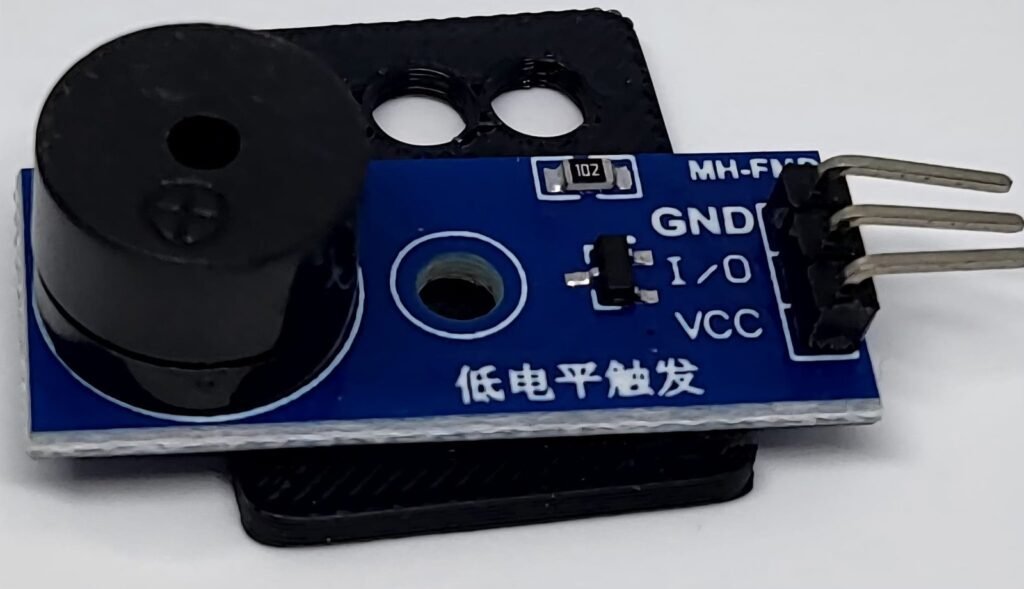
Project 2.5: "Alarm with Crash Switch"
🚀 Project 2.5 – Alarm with Crash Switch
🎯 What You’ll Learn
- ✅ Goal 1: Detect collisions using a crash switch (press sensor).
- ✅ Goal 2: Trigger alarms with LED and buzzer.
- ✅ Goal 3: Log events and build a simple safety system.
Key Ideas
- Short definition: A crash switch changes from 0 to 1 when pressed, which we use to detect impacts.
- Real-world link: Robots and machines use impact sensors to pause, alert, or protect themselves.
🧱 Blocks Glossary (used in this project)
- Digital input: Robot reads a pin as 0 or 1 to detect a press.
- Digital output: Robot turns a pin ON or OFF for LED or devices.
- Serial print: Robot sends messages to your computer screen.
- if / else: The robot makes a decision based on sensor state.
- Loop: Repeat the check forever to catch crashes as they happen.
- Delay: Pause time to make behavior stable and readable.
🧰 What You Need
| Part | How many? | Pin connection |
|---|---|---|
| D1 R32 | 1 | USB cable (30 cm) |
| Crash switch | 1 | Pin 2 (digital input) |
| LED | 1 | Pin 5 (digital output) |
| Buzzer | 1 | Pin 26 (music output) |
🔌 Wiring tip: Connect one side of the crash switch to pin 2 and the other side to GND.
📍 Pin map snapshot: Pin 2 (input), Pin 5 (LED), Pin 26 (buzzer). Others unused.
✅ Before You Start
- USB cable is plugged in
- Serial monitor is open
- Test print shows:
print("Ready!") # Confirm serial is working
🎮 Microprojects (5 Mini Missions)
🎮 Microproject 2.5.1 – Simple impact detection
Goal: Read the crash switch and print its state.
Blocks used:
- Digital input: Read pin 2 (0/1).
- Serial print: Show state on screen.
Block sequence:
- Setup pin 2 as input
- Read state
- Print state
- Repeat
MicroPython Code:
# Simple impact detection (print state)
import machine, time                          # Import pin control and time
pin2 = machine.Pin(2, machine.Pin.IN)         # Set pin 2 as digital input for crash switch
print("Crash switch detection ready")         # Serial start message
while True:                                   # Loop forever to keep checking
    state = pin2.value()                      # Read the input: 0 (no press) or 1 (pressed)
    print("Crash state:", state)              # Print the current state
    time.sleep(0.2)                           # Small delay to make output readable
Reflection: You can see when the crash switch is pressed (1) or not (0).
Challenge:
- Easy: Print “IMPACT!” only when state is 1.
- Harder: Print “Safe” when 0 and “Impact” when 1.
🎮 Microproject 2.5.2 – Collision alarm (LED + buzzer)
Goal: Turn ON LED and play a beep when an impact is detected.
Blocks used:
- Digital input: Read pin 2.
- Digital output: Control LED on pin 5.
- Music output: Play beep on pin 26.
Block sequence:
- Setup input and outputs
- If pressed → LED ON + beep
- Else → LED OFF
- Repeat
MicroPython Code:
# Collision alarm (LED + buzzer)
import machine, time, music                   # Import pin control, time, and music
pin2 = machine.Pin(2, machine.Pin.IN)         # Crash switch input on pin 2
pin5 = machine.Pin(5, machine.Pin.OUT)        # LED output on pin 5
midi = music.MIDI(26)                         # Buzzer output on pin 26 (music interface)
print("Collision alarm ready")                # Serial start message
while True:                                   # Infinite loop to monitor continuously
    if pin2.value() == 1:                     # If crash detected (pressed)
        pin5.value(1)                         # Turn LED ON
        midi.pitch_time(440, 150)             # Play short beep at 440 Hz for 150 ms
        print("IMPACT DETECTED!")             # Serial alert message
    else:                                     # If not pressed
        pin5.value(0)                         # Turn LED OFF
    time.sleep(0.1)                           # Short delay to keep response snappy
Reflection: The alarm reacts instantly to a press with light and sound.
Challenge:
- Easy: Use 523 Hz for a higher beep.
- Harder: Make two beeps when pressed (ta-ta).
🎮 Microproject 2.5.3 – Impact counter (simple tally)
Goal: Count how many times an impact happens and print the total.
Blocks used:
- Digital input: Read pin 2.
- Variable: Store the count.
- Serial print: Show count after each new impact.
Block sequence:
- Setup input
- Create counter variable
- Detect change from 0 → 1
- Increase counter and print
MicroPython Code:
# Impact counter (count presses)
import machine, time                          # Import pin control and time
pin2 = machine.Pin(2, machine.Pin.IN)         # Crash switch input on pin 2
count = 0                                     # Counter starts at 0
last = 0                                      # Last state starts at 0 (not pressed)
print("Impact counter ready")                 # Serial start message
while True:                                   # Loop forever
    state = pin2.value()                      # Read current state
    if state == 1 and last == 0:              # Detect rising edge: just pressed
        count = count + 1                     # Increase counter by 1
        print("Impact count:", count)         # Print the new count
        time.sleep(0.15)                      # Small debounce delay
    last = state                              # Update last state for next loop
    time.sleep(0.05)                          # Fast scan for responsive counting
Reflection: You track how many impacts happened, not just the current state.
Challenge:
- Easy: Reset the counter to 0 when it reaches 10.
- Harder: Add a second LED blink every 5 impacts.
🎮 Microproject 2.5.4 – Different sounds by impact
Goal: Play short or long beep depending on tap strength (simulated by duration).
Blocks used:
- Digital input: Read pin 2.
- Music output: Play beeps.
Block sequence:
- Wait for press start
- Measure how long it stays pressed
- Short press → short beep
- Long press → longer beep
MicroPython Code:
# Different sounds by impact (press duration)
import machine, time, music                   # Import pin control, time, and music
pin2 = machine.Pin(2, machine.Pin.IN)         # Crash switch input on pin 2
midi = music.MIDI(26)                         # Buzzer on pin 26
print("Impact sound mapping ready")           # Serial start message
while True:                                   # Continuous monitoring loop
    if pin2.value() == 1:                     # If pressed now
        start = time.ticks_ms()               # Record start time in milliseconds
        while pin2.value() == 1:              # Keep looping while still pressed
            time.sleep(0.01)                  # Tiny delay to avoid busy waiting
        duration = time.ticks_diff(time.ticks_ms(), start)  # Compute press time
        print("Press duration (ms):", duration)             # Show duration
        if duration < 200:                    # If short press (under 200 ms)
            midi.pitch_time(440, 150)         # Play short beep
            print("Short impact beep")        # Serial confirmation
        else:                                 # If long press (200 ms or more)
            midi.pitch_time(440, 400)         # Play long beep
            print("Long impact beep")         # Serial confirmation
    time.sleep(0.05)                          # Scan frequently for new presses
Reflection: Press length changes the sound, adding meaning to different impacts.
Challenge:
- Easy: Use 523 Hz for long presses to make them sound different.
- Harder: Add LED ON during press and OFF after release.
🎮 Microproject 2.5.5 – Anti‑collision system (stop + alert)
Goal: Stop action when an impact is detected and show an alert until safe.
Blocks used:
- Digital input: Read pin 2.
- Digital output: LED on pin 5.
- Serial print: Status messages (STOP or SAFE).
Block sequence:
- Read crash switch
- If pressed → STOP and alert
- If safe → CLEAR alert
- Repeat
MicroPython Code:
# Anti-collision system (STOP when impact)
import machine, time                          # Import pin control and time
pin2 = machine.Pin(2, machine.Pin.IN)         # Crash switch input on pin 2
pin5 = machine.Pin(5, machine.Pin.OUT)        # LED output on pin 5
print("Anti-collision ready")                 # Serial start message
while True:                                   # Continuous loop
    if pin2.value() == 1:                     # If crash detected
        pin5.value(1)                         # Turn LED ON (alert)
        print("STOP: Impact detected")        # Print STOP message
        time.sleep(0.2)                       # Hold alert briefly
    else:                                     # If safe
        pin5.value(0)                         # Turn LED OFF (clear alert)
        print("SAFE: No impact")              # Print SAFE message
        time.sleep(0.2)                       # Small delay for readability
Reflection: The system clearly shows STOP on impact and SAFE when clear.
Challenge:
- Easy: Blink LED twice when impact detected.
- Harder: Add buzzer beep only on first detection (not continuously).
✨ Main Project – Crash Alarm System
🔧 Blocks Steps (with glossary)
- Digital input: Read crash switch (pressed or not).
- Digital output: LED shows alarm state.
- Music output: Buzzer plays warning tones.
- Serial print: Clear messages for STOP and SAFE.
- Loop: Continuous monitoring to catch impacts live.
Block sequence:
- Setup input (pin 2) and outputs (pin 5, pin 26)
- Read crash switch
- If pressed → LED ON + warning beep + “STOP” serial
- If not pressed → LED OFF + “SAFE” serial
- Repeat loop
🐍 MicroPython Code (mirroring blocks)
# Project 2.5 – Alarm with Crash Switch (Main Project)
import machine, time, music                   # Import pin control, time, and music
pin2 = machine.Pin(2, machine.Pin.IN)         # Crash switch input on pin 2
pin5 = machine.Pin(5, machine.Pin.OUT)        # LED output on pin 5
midi = music.MIDI(26)                         # Buzzer output on pin 26
print("Crash Alarm Main ready")               # Serial start message
while True:                                   # Infinite loop to monitor continuously
    state = pin2.value()                      # Read crash switch: 0 (safe) or 1 (impact)
    if state == 1:                            # If impact detected
        pin5.value(1)                         # LED ON (alarm)
        midi.pitch_time(440, 200)             # Warning beep (440 Hz, 200 ms)
        print("STOP: Impact detected")        # Serial STOP message
        time.sleep(0.2)                       # Short delay to avoid spam
    else:                                     # If safe
        pin5.value(0)                         # LED OFF
        print("SAFE: No impact")              # Serial SAFE message
        time.sleep(0.2)                       # Short delay for readability
📖 External Explanation
- What it teaches: You built a practical safety alarm that reacts to impacts with light, sound, and messages.
- Why it works: The crash switch gives a reliable 0/1 reading; if it’s pressed, the program triggers alarms and prints STOP; if not, it prints SAFE and turns the LED OFF.
- Key concept: Inputs change outputs — sensors drive decisions.
✨ Story Time
Your robot is now a careful driver. If it bumps into something, it stops and flashes a warning. When the path is clear, it relaxes and turns the light off. Safety first, hero second.
🕵️ Debugging (2 Common Problems)
🐞 Debugging 2.5.A – Overly sensitive detection
Problem: Alarm triggers too easily or keeps blinking.
Clues: Rapid STOP/SAFE messages in serial.
Broken code:
time.sleep(0.01) # Too fast, causes noisy readings
Fixed code:
time.sleep(0.2) # Reasonable delay to filter noise and bouncing
Why it works: A small delay reduces false triggers and switch bounce.
Avoid next time: Add a short debounce delay after each detection.
🐞 Debugging 2.5.B – Does not detect minor impacts
Problem: Light taps are not detected.
Clues: State stays at 0 even when tapped.
Broken code:
if pin2.value() == 1:   # Only checks pressed, misses short taps
    print("Impact")
Fixed code:
last = 0                                # Track last state
state = pin2.value()                     # Read current state
if state == 1 and last == 0:             # Catch rising edge (just pressed)
    print("Impact detected")             # Log the event
last = state                             # Update last state
Why it works: Edge detection captures quick taps that a simple pressed check might miss.
Avoid next time: Use a short debounce and track state changes.
✅ Final Checklist
- I saw “STOP: Impact detected” when pressing the switch.
- I saw “SAFE: No impact” when releasing the switch.
- The LED matched the serial messages.
- My beep played on impact.
- My challenge changes worked (double beep or LED blink).
📚 Extras
- 🧠 Student tip: Add a “safe mode” light pulse every 2 seconds when no impact happens.
- 🧑🏫 Instructor tip: Demonstrate mechanical switch bounce and why we add short delays.
- 📖 Glossary: Crash switch (press sensor), debounce (filtering noisy presses), rising edge (0 to 1 change).
- 💡 Mini tips:
- Pins: Use Pin numbers (like 2, 5, 26).
- Delays: Small delays help stabilize sensors.
- Serial: Print short messages students can read fast.