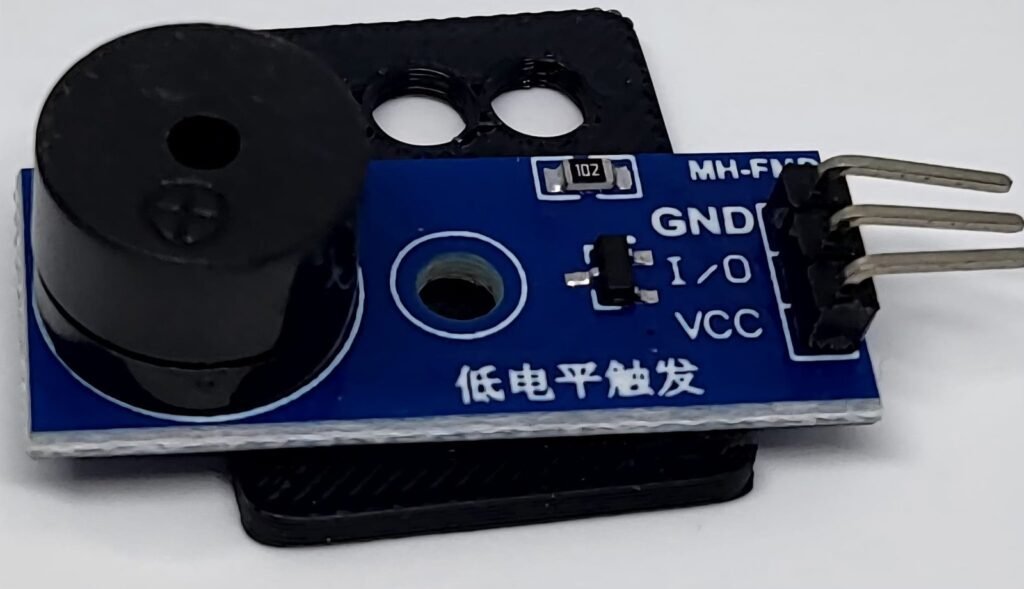
Project 1.7: "Digital Sensors"
🚀 Project 1.7 – Digital Sensors
🎯 What You’ll Learn
- ✅ Goal 1: Read button states.
- ✅ Goal 2: Control LEDs and motors with button input.
- ✅ Goal 3: Handle bouncing and create counters.
Key Ideas
- Digital input: Detect HIGH/LOW from a button.
- Digital output: Control LEDs or motors.
- Logic: Use button state to trigger actions.
🧱 Blocks Glossary (used in this project)
pinX = machine.Pin(X, machine.Pin.IN)→ Button input.pinX = machine.Pin(X, machine.Pin.IN, machine.Pin.PULL_UP)→ Button input with pull‑up.pinX = machine.Pin(X, machine.Pin.OUT)→ LED or motor output.pinX.value()→ Read pin state.pinX.value(1)→ Set pin HIGH (ON).pinX.value(0)→ Set pin LOW (OFF).while True:→ Infinite loop.time.sleep()→ Delay.
🧰 What You Need
| Part | How many? | Pin connection |
|---|---|---|
| D1 R32 | 1 | USB cable |
| Push Button | 2 | Pin 2, Pin 4 |
| LED | 1 | Pin 5 |
🔌 Wiring tip: Connect button one to pin 2, button two to pin 4, LED to pin 5.
📍 Pin map snapshot: Pin 2/4 = buttons, Pin 5 = LED.
✅ Before You Start
- USB cable connected
- Buttons wired correctly
- Test print shows:
print("Ready!") # Confirm serial is working
🎮 Microprojects (5 Mini Missions)
🎮 Microproject 1.7.1 – Reading button status
Blocks used: Digital input, Serial print
Block sequence:
- Setup button pin as input
- Read value
- Print state
MicroPython Code:
import machine, time                          # Import modules
pin2 = machine.Pin(2, machine.Pin.IN)         # Pin 2 as input for button
while True:                                   # Infinite loop
    state = pin2.value()                      # Read button state (0 or 1)
    print("Button state:", state)             # Serial log of button state
    time.sleep(0.5)                           # Delay for readability
Reflection: Button state is read continuously.
Challenge: Try changing the pin to 4 for the second button.
🎮 Microproject 1.7.2 – Button‑controlled LED
Blocks used: Digital input, Digital output
Block sequence:
- Setup button pin as input
- Setup LED pin as output
- If button pressed → LED ON
MicroPython Code:
import machine, time                          # Import modules
pin2 = machine.Pin(2, machine.Pin.IN)         # Pin 2 as input for button
pin5 = machine.Pin(5, machine.Pin.OUT)        # Pin 5 as output for LED
while True:                                   # Infinite loop
    if pin2.value() == 1:                     # If button pressed
        pin5.value(1)                         # Turn LED ON
        print("LED ON")                       # Serial log
    else:                                     # If button not pressed
        pin5.value(0)                         # Turn LED OFF
        print("LED OFF")                      # Serial log
    time.sleep(0.2)                           # Delay for stability
Reflection: LED responds to button press.
Challenge: Add a second button to control LED OFF.
🎮 Microproject 1.7.3 – Heart rate counter
Blocks used: Digital input, Counter, Serial print
Block sequence:
- Setup button pin as input
- Count presses
- Print count
MicroPython Code:
import machine, time                          # Import modules
pin2 = machine.Pin(2, machine.Pin.IN)         # Pin 2 as input for button
count = 0                                     # Initialize counter
while True:                                   # Infinite loop
    if pin2.value() == 1:                     # If button pressed
        count += 1                            # Increase counter
        print("Heart rate count:", count)     # Serial log of count
        time.sleep(0.5)                       # Delay to avoid double count
Reflection: Button press increments counter.
Challenge: Try counting for 10 seconds and calculate beats per minute.
🎮 Microproject 1.7.4 – Anti‑bounce software
Blocks used: Digital input, Delay
Block sequence:
- Setup button pin as input
- Add delay after press
- Prevent multiple counts
MicroPython Code:
import machine, time                          # Import modules
pin2 = machine.Pin(2, machine.Pin.IN)         # Pin 2 as input for button
count = 0                                     # Initialize counter
while True:                                   # Infinite loop
    if pin2.value() == 1:                     # If button pressed
        count += 1                            # Increase counter
        print("Count:", count)                # Serial log
        time.sleep(0.3)                       # Delay prevents bouncing
Reflection: Delay reduces false counts.
Challenge: Try adjusting delay to 0.1s or 0.5s.
🎮 Microproject 1.7.5 – Motor control with button
Blocks used: Digital input, Digital output, PWM
Block sequence:
- Setup button pin as input
- Setup motor pins as output + PWM
- If button pressed → Motor ON
MicroPython Code:
import machine, time                          # Import modules
pin2 = machine.Pin(2, machine.Pin.IN)         # Pin 2 as input for button
pin12 = machine.Pin(12, machine.Pin.OUT)      # Motor IN3 output
pin13 = machine.Pin(13, machine.Pin.OUT)      # Motor IN4 output
pwm14 = machine.PWM(machine.Pin(14))          # Motor ENB PWM
pwm14.freq(2000)                              # Set PWM frequency
pwm14.duty(0)                                 # Start with motor OFF
while True:                                   # Infinite loop
    if pin2.value() == 1:                     # If button pressed
        pin12.value(1)                        # Motor forward IN3 HIGH
        pin13.value(0)                        # Motor forward IN4 LOW
        pwm14.duty(512)                       # Motor speed 50%
        print("Motor ON")                     # Serial log
    else:                                     # If button not pressed
        pwm14.duty(0)                         # Motor OFF
        print("Motor OFF")                    # Serial log
    time.sleep(0.2)                           # Delay for stability
Reflection: Button press controls motor.
Challenge: Add second button to reverse motor direction.
✨ Main Project – Digital Sensors
🔧 Blocks Steps (with glossary)
- Digital input: Read button state.
- Digital output: Control LED or motor.
- Logic: Use button state for actions.
Block sequence:
- Setup pins for buttons and outputs.
- Read button state.
- Control LED or motor.
- Add counter and anti‑bounce.
MicroPython Code (mirroring blocks):
# Project 1.7 – Digital Sensors
import machine, time                          # Import required modules
pin2 = machine.Pin(2, machine.Pin.IN)         # Pin 2 input for button
pin5 = machine.Pin(5, machine.Pin.OUT)        # Pin 5 output for LED
count = 0                                     # Initialize counter
while True:                                   # Infinite loop
    if pin2.value() == 1:                     # If button pressed
        pin5.value(1)                         # LED ON
        count += 1                            # Increase counter
        print("LED ON, Count:", count)        # Serial log
        time.sleep(0.3)                       # Anti‑bounce delay
    else:                                     # If button not pressed
        pin5.value(0)                         # LED OFF
        print("LED OFF")                      # Serial log
        time.sleep(0.1)                       # Short delay
📖 External Explanation
This project shows how to use buttons as digital sensors.
- Inputs detect button presses.
- Outputs respond with LEDs or motors.
- Counters and delays handle bouncing and measure events.
- By combining these, students learn how sensors trigger actions in robotics.
✨ Story Time
Imagine your robot as a game controller 🎮. Each button press lights up an LED, starts a motor, or counts a heartbeat. With anti‑bounce, the robot avoids mistakes and responds smoothly, just like a professional device.
🕵️ Debugging (2 Common Problems)
🐞 Debugging 1.7.A – Inverted button state
Problem: Button reads pressed when it is not pressed.
Clues: Pull‑up or pull‑down resistor not set correctly.
Broken code:
pin2 = machine.Pin(2, machine.Pin.IN) # Input without pull-up/down
Fixed code:
pin2 = machine.Pin(2, machine.Pin.IN, machine.Pin.PULL_UP) # Correct pull-up
Why it works: Adding a pull‑up ensures the button reads HIGH only when pressed.
Avoid next time: Always check if your button wiring requires pull‑up or pull‑down.
🐞 Debugging 1.7.B – Uncontrolled rebounds
Problem: Button press counts multiple times.
Clues: Mechanical bounce causes repeated signals.
Broken code:
if pin2.value() == 1:
    count += 1
    print("Count:", count)
Fixed code:
if pin2.value() == 1:
    count += 1
    print("Count:", count)
    time.sleep(0.3)   # Anti-bounce delay
Why it works: Adding a short delay filters out bounce signals.
Avoid next time: Always include anti‑bounce logic when counting button presses.
✅ Final Checklist
- Button state read correctly.
- LED controlled by button.
- Counter increments with presses.
- Anti‑bounce implemented.
- Motor controlled by button.
📚 Extras
- 🧠 Student tip: Try combining two buttons—one for ON and one for OFF.
- 🧑🏫 Instructor tip: Demonstrate bounce by showing rapid counts without delay.
- 📖 Glossary: Digital input, pull‑up, bounce, counter.
- 💡 Mini tip: Always test button state with
print()before connecting to outputs.