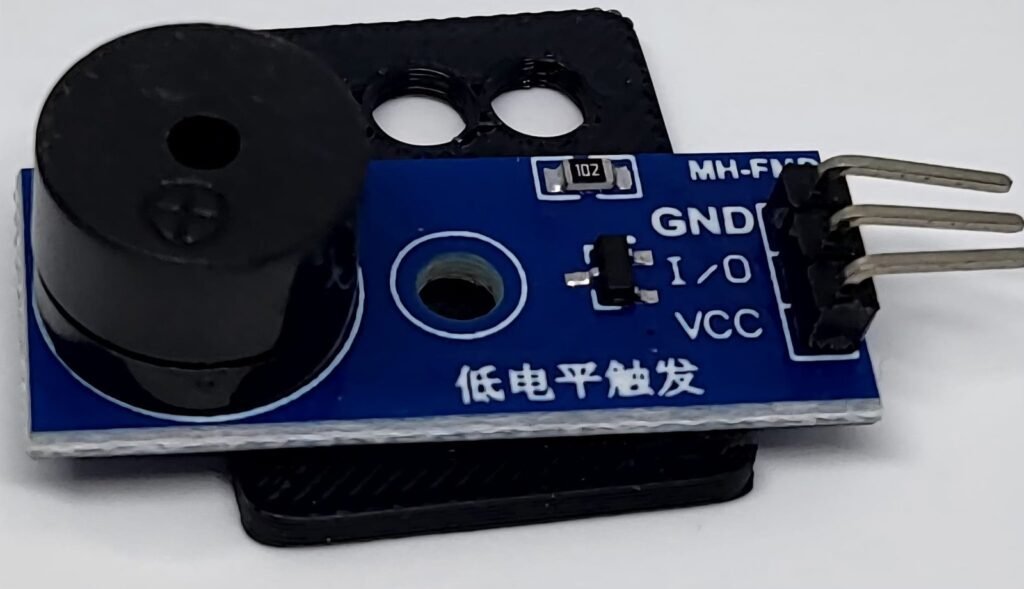
Blocks Area
External Sensor
📊 External Sensor – Your “Extra Senses”
What it is: Blocks for reading data from external sensors.
What it does: Connects to and reads specialized sensors.
Example: Measures light, temperature, or distance.
👉 These are the robot’s senses (sight, hearing, touch).
🧩 Fun Guide to External Sensors Blocks (Clu-blocks Pro)
🌍 Important! These blocks let your robot sense the world around it — temperature, motion, distance, and more. It’s like giving your robot eyes, ears, and skin!
🛠️ I2C Setup & Sensor Configuration
| # | Block | What it does | Dropdown options | What the options mean |
|---|---|---|---|---|
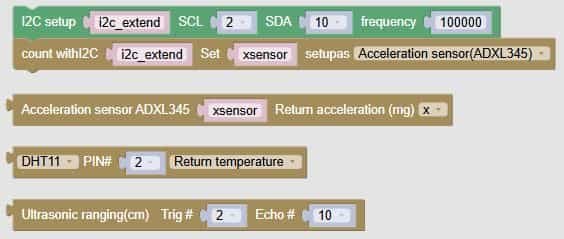
| 1 | I2C setup → I2C extend → SCL = 2, SDA = 10, frequency = 100000 |
Sets up I2C communication | — | Needed for sensors like accelerometers — SCL/SDA are data pins |
| 2 | count with I2C → I2C extend → xsensor → Acceleration sensor (ADXL345) |
Initializes an I2C sensor | — | Prepares the ADXL345 to start sending data |
🌀 Motion Sensor (Accelerometer ADXL345)
| # | Block | What it does | Dropdown options | What the options mean |
|---|---|---|---|---|
| 3 | Acceleration sensor ADXL345 → xsensor → Return acceleration (mg) → x |
Reads acceleration data | x, y, z, (x,y,z) |
Choose which axis to read — or all three at once |
🌡️ Temperature & Humidity Sensor (DHT11)
| # | Block | What it does | Dropdown options | What the options mean |
|---|---|---|---|---|
| 4 | DHT11 → PIN# 2 → Return temperature |
Reads temperature from DHT11 | Return temperature, getHumidity |
Choose whether to read temperature or humidity |
📏 Distance Sensor (Ultrasonic)
| # | Block | What it does | Dropdown options | What the options mean |
|---|---|---|---|---|
| 5 | Ultrasonic ranging (cm) → Trig # 2, Echo # 10 |
Measures distance using sound | — | Sends a sound pulse and measures how long it takes to bounce back — great for obstacle detection |
🧠 Quick Tips for Students
- Use I2C setup before using any I2C sensor — it’s like plugging in the wires.
- Use ADXL345 to detect movement, tilt, or vibration — perfect for motion-triggered actions.
- Use DHT11 to monitor room conditions — like turning on a fan if it’s hot.
- Use Ultrasonic to avoid obstacles — great for robot navigation or parking sensors.
- Combine sensors to make smart robots — like a weather station or a self-driving rover!